





Contemporary horticulture
Media registration certificate: ЭЛ № ФС 77 - 77630 от 31.12.2019
The journal publishes original articles reflecting the problems and results of fundamental and applied scientific research in the field of genetics, breeding, variety study, introduction, biotechnology, physiology, biochemistry, immunity, agrochemistry, nursery, storage technologies, processing and cultivation of fruit, berry and ornamental plants.
A special feature of the journal is the unlimited length of the article, which gives the authors the opportunity to present in detail the results of their research.
For greater clarity, detail, and attention, authors can attach additional materials to the article that for one reason or another are not included in the text of the article, for example, voluminous tables with data, drawings, videos, etc.
By agreement with the editors, short messages, reviews, and advertisements may be published.
The publisher and editors do not charge a fee for acceptance, review, editorial preparation and publication of an article in the journal.
Founder
Russian Research Institute of Fruit Crop Breeding (VNIISPK)
Editor-in-Chief
Sergey Knyazev, Doctor of Agr. Sci, Professor
Frequency / Access
4 issues per year / Open
Included in
Higher Attestation Commission List, RISC
Journal archive 2011...2023
Current Issue
No 3 (2025)
- Year: 2025
- Published: 05.12.2025
- Articles: 11
- URL: https://journal-vniispk.ru/2312-6701/issue/view/23900
-
Description:
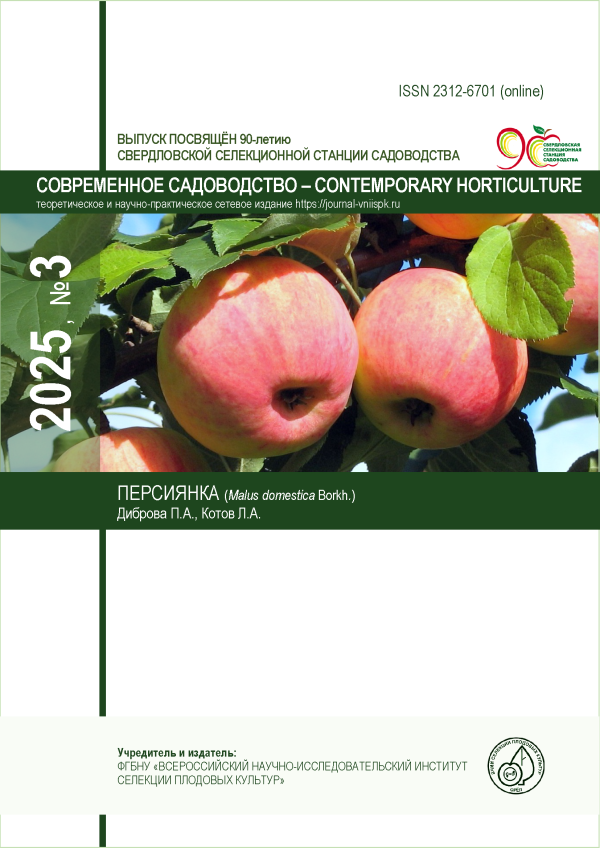
Выпуск посвящён 90-летию Свердловской селекционной станции садоводства
Full Issue

Genetics, breeding, study of varieties
History and current state of pear breeding in the Middle Urals (review)
Abstract
The Sverdlovsk Breeding Station of Horticulture has been breeding pears for 90 years. The pear varieties developed here are adapted to the harsh climatic conditions of the Middle Urals. All breeding work is based on the most frost-hardy pear species — Pyrus ussuriensis Maxim. Initially, the crossbreeding was aimed at obtaining first-generation hybrids from the Ussuri pear, which were mostly highly winter-hardy and had low-quality fruits. The next stage of breeding work involved crossing first-generation hybrids from the Ussuri pear with varieties from the southern horticultural zone. This method was used to create most of the station's modern varieties. Currently, crossbreeding is being conducted between second-generation hybrids, as well as saturation crosses of first- and second-generation hybrids with varieties native to the southern horticultural zone. This method has produced a large number of elite pear seedlings. Currently, the state register of breeding achievements approved for use contains 11 pear varieties developed by the Sverdlovsk Breeding Station of Horticulture. The breeders who made the main contributions to the creation of these pear varieties include P.A. Dibrova (years of work 1938—1965), L.A. Kotov (years of work 1963—2020), and D.D. Telezhinskiy (1999—present).
 5-15
5-15


History of research and major achievements at the present stage in the study and breeding of currants in the Middle Urals (review)
Abstract
For 90 years, the Sverdlovsk Breeding Station of Horticulture has been continuously building a currant bioresource collection, improving the assortment for cultivation in the Middle Urals, and identifying sources of economically useful traits for further research. The main contribution to the breeding of black currant was made by candidates of agricultural sciences G.A. Zakharov and T.V. Shagina. By the end of 2025, the State Register of Breeding Achievements Approved for Use in the Russian Federation has included 10 varieties created at the Sverdlovsk Breeding Station of Horticulture - structural subdivision FSBSI UrFASRC, UrB of RAS. Currently, research is being conducted in the Middle Urals using modern methods and technologies. Due to the expansion of berry production areas, work has begun on developing blackcurrant varieties suitable for mechanized harvesting. 5 varieties were selected based on a set of characteristics. In 2024—2025, genetic polymorphism of the original and breeding material was studied using microsatellite loci, and profiles for the genetic identification of 33 varieties were obtained. The study demonstrated that R. nigrum loci located in different linkage groups can be amplified ‘in a single test tube.’ The scientific collaboration contributes to the increased efficiency of scientific research. In 2020, jointly with the Federal Research Center N. I. Vavilov All-Russian Institute of Plant Genetic Resources (VIR), nomenclature standards for 24 blackcurrant cultivar accessions bred by the Sverdlovsk BSH were registered in the VIR Herbarium database and transferred for storage to the Model Fund of the Herbarium of Cultivated Plants of the World, their Wild Relatives, and Weeds (WIR). From 2021 to 2023, research on the antioxidant content and biochemical indicators of currant berries was conducted jointly with the Ural State University of Economics. 23 varieties of black currant and 10 varieties of red currant were studied.
16-31
Screening of strawberry cultivars bred by Sverdlovsk Horticultural Breeding Station for the presence of 08 To-f loci of resistance
Abstract
The development of strawberry cultivars with genetic determinants of resistance to fungal pathogens is a priority in modern breeding. The aim of the research was to identify the 08 To-f locus of resistance to powdery mildew in 11 strawberry cultivars of the Sverdlovsk Horticultural Breeding Station using DNA-markers. To identify the resistance locus, the dominant diagnostic DNA marker IB535110 was used, and the PCR process was controlled using the marker EMFv020. ‘Malwina’ was used as a positive control with QTL 08 To-f. As a result of molecular genetic screening, QTL 08 To-f was identified in two cultivars of the collection: ‘Duet’ and ‘Italmas’, these cultivars will be used in our breeding program to obtain powdery mildew-resistant cultivars.
32-39
Breeding prospects for improving yield productivity and quality of black currant in the arid zone of Yenisei Siberia
Abstract
Black currant occupies the largest cultivated area among berry crops in Siberian orchards. However, its productivity potential is not provided due to increasing environmental risks, particularly the growing aridity of the region, deteriorating phytosanitary conditions in orchard ecosystems (orchard phytocoenosis), and rising human impact on the environment. Under these circumstances, the continuous improvement of the cultivar assortment can be achieved through the development of adaptive breeding material. The objective of the research was to evaluate the black currant hybrid collection under arid steppe conditions of the southern Krasnoyarsk region for productivity, early maturation, large fruit size, taste qualities, long fruiting cluster, and uniform ripening berry period, with identification of valuable genetic sources, effective breeding approaches, and optimal crossing schemes. The study was conducted at the Minusinsk Department of Fruit and Berry Crops, Krasnoyarsk Research Institute of Agriculture «Federal Research Center Krasnoyarsk Scientific Center of the Siberian Branch of the Russian Academy of Sciences», (2018—2024). The objects of the study were 1935 seedlings from 27 breeding families generated in 2018—2019 through hybridization, using original samples of Minusinsk, Altai, Scandinavian, North American, and West European origin. The hybrid material was evaluated according to standard methodologies. The highest proportion of high-yielding hybrids was obtained in crosses involving the following maternal parents: Minusinskaya Stepnaya (8.5%), Otradnaya (6.1%), 12-76-9 (5.8%), and Dostoynaya (4.5%). The best hybrid families for early maturity were: Otradnaya × (3-75-1 + 3-75-3) (83.2%), Minusinskaya Stepnaya × Sayansky Souvenir (78.1%), and Dostoynaya × (3-75-1 + 3-75-3). The highest yield of large-berried specimens was observed in the families involving cultivars Otradnaya, Dostoynaya, and elite selections 5-63-3, 5-63-1, and 12-76-9. Mediocre and poor berry taste predominated in the progeny (average 80.9%, ranging from 42.8% to 87.1%). Good berry taste was observed in 18.4% of seedlings, with only 14 hybrids (0.7%) exhibiting excellent taste. Among the hybrids, long-clustered types (with more than 8 berries per cluster) accounted for merely 1.7%, medium-clustered (5—7 berries) predominated at 85.1%, while short-clustered types constituted 13.2%. Hybrid plants with uniform berry ripening represented 36.7% of the population. The cultivar Otradnaya demonstrated the highest yield of such hybrids (up to 39.1%), with its hybrid families showing 30.8-54.2% uniformity. Over the study period, 18 promising forms were selected from the hybrid collection, combining enhanced productivity and superior fruit quality while maintaining winter hardiness, drought and heat tolerance, and resistance to major pathogens. The most effective combinations of crosses were: Otradnaya × (3-75-1 + 3-75-3), Minusinskaya Stepnaya × Sayansky Souvenir, Dostoynaya × (3-75-1 + 3-75-3), Otradnaya × 12-76-9, Otradnaya × Syanets Golubki, 12-76-9 × Otradnaya, and 12-76-9 × Dostoynaya.
40-53
Nomenсlatural standards of honeysuckle cultivars created South Ural Research Institute of Horticulture and Potato Growing
Abstract
The creation and promulgation of nomenclatural standards is necessary to fix the name of a cultivar to its appearance and therefore to a certain set of genetic information. Nomenclatural standards are of great importance for securing the copyrights of the creators of the cultivar, and also allow users to avoid heterogeneity or clogging of cultivars plantings. Our publication designates the nomenclatural standards of 6 honeysuckle cultivars created in the South Ural Research Institute of Horticulture and Potato Growing: ‘Amazonka’, ‘Gorlinka’, ‘Elizaveta’, ‘Lazurit’, ‘Mariya’, and ‘Ural`skaya’. The nomenclatural standards have been created on the basis of the honeysuckle collection of the Sverdlovsk Breeding Station of Horticulture – structural subdivision of the Federal State Budgetary Scientific Institution «Ural Federal Agrarian Scientific Research Centre, Ural Branch of the Russian Academy of Science» and are designed in accordance with International code of nomenclature for cultivated plants (ICNCP) recommendations. The herbarium model of the nomenclatural standard of each cultivar is represented by one herbarium folio, which contains parts of one plant collected twice during the growing season: flowers ‒ during flowering; fruits and annual shoots ‒ during fruiting. The plant material for the nomenclatural standards was selected under the guidance of an expert (E.M. Chebotok) from the plants with typical cultivar characteristics. Herbarium sheets are supplemented with photo of flowers and fruits and are signed by an expert. Nomenclatural standards have been registered in the VIR Herbarium database and, together with the accompanying documents, have been deposited in the standard fund of the Herbarium of Cultivated Plants of the World, Their Wild Relatives and Weeds (WIR), to the National Center for Plant Genetic Resources. The created nomenclatural standards can be used as a carrier of authenticity of the genetic information of the cultivar as a breeding achievement.
54-72
Nursery and horticulture
Application of metal nanoparticles in the propagation of Ribes atropurpureum C.A. Mey. and their hybrids using softwood cuttings
Abstract
Red currants are one of the key berry crops in temperate zones, in demand both fresh and for processing thanks to their stable yield and technological properties. Accelerating the introduction of new varieties and hybrids requires effective and reproducible methods of vegetative propagation, primarily softwood cuttings. The aim of the study was to evaluate the effect of cobalt (Co) and silicon (Si) doped biogenic ferrihydrite nanoparticles on the rooting and root system quality of Ribes atropurpureum and its hybrids during the propagation by softwood-cuttings. The cuttings were treated with a solution of nanoparticles and then rooted in a sandy substrate. The proportion of rooted cuttings, the number and length of first-order roots were studied. The treatment had a multidirectional effect, strictly dependent on the genotype. For the hard-to-root R. atropurpureum, treatment with nanoparticles at a concentration of 1 mg/l had a stimulating effect: rooting increased from 50% (control) to 73.3% (Co), as well as improved morphometric parameters of the root system and its branching. On the contrary, in interspecific hybrids with initially high rootability (86.7—100%), the use of the same nanoparticles led to a decrease in the percentage of rooting (to 73.3—76.7%) and a deterioration in the quality of the root system. The greatest negative effect in the hybrids was associated with treatment with a solution of biogenic ferrihydrite nanoparticles doped with cobalt. It was concluded that pre-planting treatment of cuttings with Co and Si nanoparticles is promising for intensifying the vegetative propagation of R. atropurpureum and its hybrids, taking into account the species and genotypic specificity of the reaction.
73-87
Influence of plant growth regulators and method of vegetative propagation on the generative productivity of garden strawberry plantlets
Abstract
The relevance of the study stems from the need to optimize the technology of clonal micropropagation Fragaria × ananassa to obtain high-quality planting material with high productivity and preservation of varietal identity. The study investigated the influence of cytokinins (6-benzylaminopurine and thidiazuron) on the generative productivity of the plantlets of the cvs. Solnechnaya Polyanka and Alfa during two years of in vivo conditions. Clonal micropropagation contributed to the accelerated entry of the plantlets into the generative phase of development compared to plants propagated using the traditional method, ensuring fruiting already in the first year of cultivation. The impact of growth regulators on the components of generative productivity in the studied cultivars varied: thidiazuron increased the number of fruits in the cv. Solnechnaya Polyanka, and 6-benzylaminopurine increased it in the cv. Alpha. The effect of growth regulators decreased by the second year, and their effect on fruit weight also depended on genotype. In the cv. Solnechnaya Polyanka, 6-benzylaminopurine increased the weight of fruits of the 1st and 2nd order, while in the cv. Alpha, thidiazuron, increasing the weight of fruits, reduced their total number. The development of effective protocols for clonal micropropagation of garden strawberry requires an individualized approach to each cultivar, taking into account the genotypic characteristics to achieve maximum productivity and maintain varietal identity.
88-97
Contents of biologically active phenolic compounds in sea buckthorn fruits (Hippophaё rhamnoides L.) under the conditions of the south of Western Siberia
Abstract
Sea buckthorn (Hippophaë rhamnoides L.) is a unique plant species of the European and Asian flora, which fruits contain a complex of biologically active compounds with valuable biological and pharmacological properties. Currently, the species is recognized as one of the most in-demand plant sources of raw materials for the food, pharmaceutical, and cosmetic industries. It occupies an important place in the system of public health preservation and improvement. Among the most important biologically active substances that make a significant contribution to the therapeutic and preventive potential of the species are phenolic compounds, particularly bioflavonoids, the most significant natural antioxidants. Despite numerous experimental data on the phytochemical composition of sea buckthorn fruits, the information on the flavonoid content of berries grown in the southern regions of Western Siberia remains limited. The objective of this study was to identify the specific patterns of accumulation of biologically active phenolic compounds in the berries of sea buckthorn (Hippophaë rhamnoides L.) cultivated in the forest-steppe zone of the Altai Territory, as well as to identify promising forms with high and stable corresponding values under variable environmental conditions. The studies were conducted from 2021 to 2023. The objects of investigation were fresh ripe fruits of sea buckthorn cultivars and hybrid forms. The total content of bioflavonoids and individual fractions (anthocyanins, flavans, flavonols) was determined in ethanol extracts of the fruits using spectrophotometric and colorimetric methods. Cultivar-specific differences and ranges of variation for the respective parameters were identified. Promising genotypes of interest for this trait were identified. The content of phenolic compounds in sea buckthorn berries grown in the southern regions of Western Siberia averaged 387.7 mg/100 g, with a variation range of 298.6 to 508.2 mg/100 g. The cultivars Etna and Afina, along with the hybrid forms 79-01-1, 170-03-1, and 360-05-1, were identified as promising sources of high phenolic content. The dominant fraction of the fruit bioflavonoid complex consisted of procyanidins (66.0%), followed by a substantial proportion of flavonols (22.8%), catechins (10.8%), and a minimal proportion of anthocyanins (0.4%). It was found that the level of bioflavonoid accumulation strongly depended on the sum of active temperatures during the vegetation period. The cultivars and hybrid forms characterized by high trait homeostasis included Etna, 360-05-1, 125-02-1, and 79-01-1.
98-109
The impact of combined mineral nutrition systems on the productivity of apple varieties and the economic efficiency of their use
Abstract
The apple tree occupies a key position in agricultural fruit production in our country and the Stavropol territory. Increasing its productivity is a key objective for food security and minimizing the volume of imported fruits. The aim of the study was to investigate the influence of combined mineral nutrition systems on the number of ovaries after the third wave of fruit drop, the average fruit weight, the productivity of apple varieties and the economic efficiency of using such nutrition systems. The experiment includes two factors: factor A – nutrition system (control (without fertilizers); fertigation system; combined system (fertigation + foliar feeding)), factor B – apple varieties (Fuji, Golden Delicious, Gala). The experiment was conducted on the territory of the Scientific and Production Association Agropark «Krasochnoe» located in the Ipatovsky urban district of Stavropol territory in 2023—2025. The planting pattern was 3,5 × 0,8 m2. The experiment was repeated 3 times. Ten of the most typical fruit trees in the middle of the row were counted in the sample plots. The sample plot area was 28 m² and the total experimental area was 504 m². Field and laboratory studies, as well as mathematical data processing, were conducted in accordance with current state standards and methods. The research results demonstrated a significant increase in the number of ovaries remaining on a fruit tree after the third wave of fruit drop when using a combined nutrition system compared to the control. An increase in the average fruit weight and yield was noted for all varieties in the third variant of the experiment (fertigation + foliar feeding) where the predominant indicators were recorded for the Golden Delicious variety (average fruit weight 248 g, yield 20.5 t/ha). A very high correlation was found between yield for all apple varieties, the number of ovaries, and average fruit weight. The use of combined mineral nutrition systems is cost-effective under production conditions (162% for Fuji, 234% for Golden Delicious and 135% for Gala).
110-122
Powdery mildews (Helotiales, Erysiphaceae) on perennial fruit crops in Sverdlovsk Region (Russia)
Abstract
Powdery mildews are a widespread group of plant pathogens, capable of causing serious yield losses. This study aims to outline species composition of powdery mildew fungi infecting fruit crops in Sverdlovsk region of Russia. Original collections and IPAE UB RAS herbarium specimens were studied and literature analysis was conducted. The results reveal 21 species of powdery mildews infecting 29 species of host plants from 11 families in Sverdlovsk Region. Most of the fungi are alien to the region. The majority of fungal species belong to Podosphaera genus. Shares of abundant, rare and single-time collected powdery mildews are equal. Abundant species belong to Podosphaera and Erysiphe genera. Raspberry-infecting fungus Podosphaera ruborum (Rabenh.) M. Bradshaw, U. Braun et M. Liu is recorded in the region for the first time. The majority of host plant species belong to Rosaceae. More species of powdery mildews might be soon found on fruit crops in Sverdlovsk region due to climate change, introduction of new cultures and arrival of new pathogenic fungi.
123-132
Selection of optimal conditions for growing arugula in hydroponic culture
Abstract
Growing arugula (Eruca sativa Mill.) in greenhouses is a popular trend, driven by the expansion of vegetable crops in Russia, the development of a healthy lifestyle, and increased consumption of leaf vegetables. The valuable organoleptic qualities of rocket leaves and microgreens are increasingly making it an ingredient in a wide variety of dishes, and the plant is also used in therapeutic nutrition. Since the plant is consumed fresh year-round, it is important to optimize cultivation methods for this crop, taking into account modern technological capabilities for growing in green houses. The aim of this study was to determine the optimal conditions for growing arugula in a multistory horizontal hydroponic system with periodic flooding. The study was conducted to examine the influence of seeding density and nutrient solution on the growth and yield of the arugula (cv. Victoria). When setting up the vegetation experiment, different seeding densities were used: 105, 210, and 315 plants per square meter. A mixture of peat and agroperlite was used as a substrate. The irrigation was performed using a periodic flooding method with three nutrient solution variants with different mineral concentrations (680, 1100, and 1370 ppm). The luminous flux intensity was 160 W/m2. An automated control system controlled the lighting regime, with day and night cycles occurring every 12 hours. The experiment lasted 50 days and the plant growth dynamics was monitored by counting leaves. The obtained data was statistically processed. A regression model was constructed taking into account three parameters: yield, number of plants per pot, and nutrient concentration in the solution. It was determined that the maximum number of leaves and fresh mass were obtained at a planting density of 210 plants per 1 m2. Optimal conditions for cv. Victoria growing to obtain the maximum yield of leaves were determined: a raw material yield per pot of more than 80 g when sowing 11 seeds per pot (231 plants per 1 m2) and a nutrient solution concentration of 1344 ppm with an NPK ratio of 14:9:20.
133-142